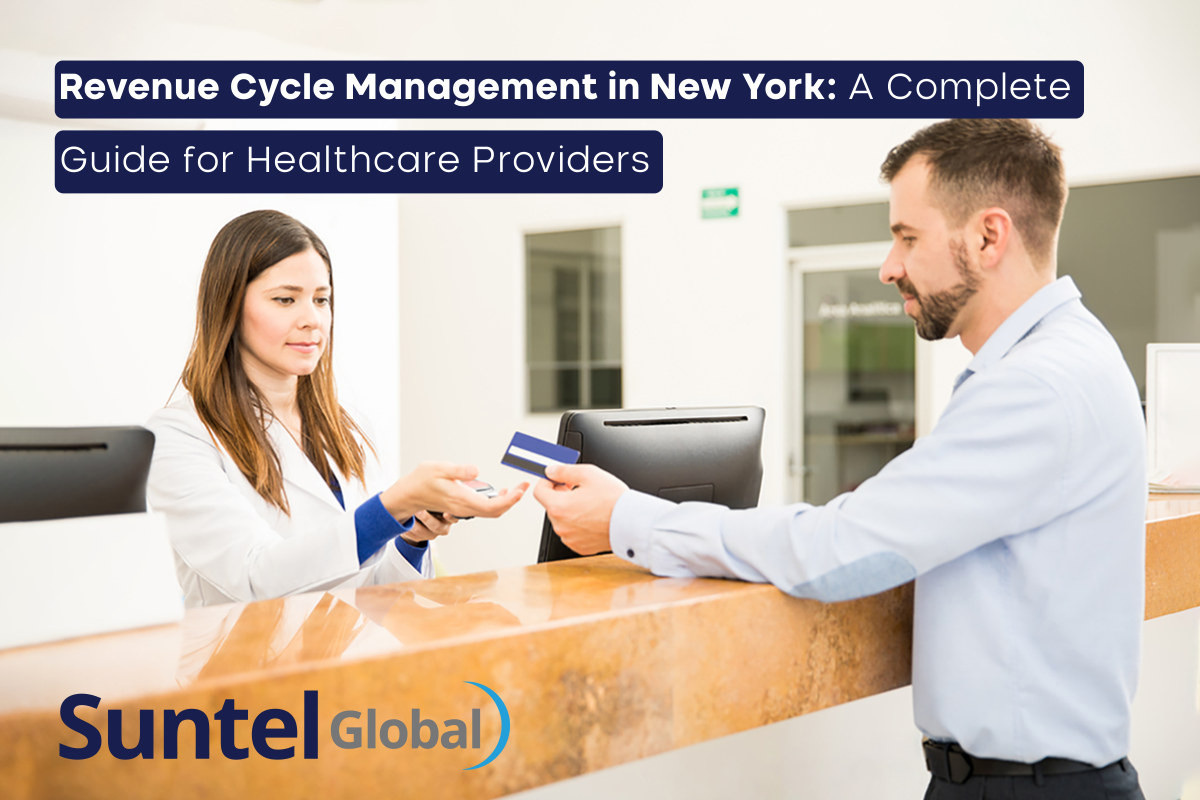
Revenue Cycle Management in New York: A Complete Guide for Healthcare Providers
Simplify your billing operations, accelerate reimbursements and stay ahead of New York's evolving healthcare regulations — with the right RCM partner by your side.
Healthcare providers in New York operate in one of the most financially and administratively demanding environments in the United States. From independent physician practices in Buffalo to large hospital systems in Manhattan, every organization shares a common challenge: keeping the revenue cycle running smoothly while delivering high-quality patient care.
Revenue Cycle Management (RCM) in New York is more than a billing function — it is the financial backbone of a healthcare organization. When managed well, it enables faster reimbursements, fewer denied claims, stronger compliance and greater operational clarity. When mismanaged, it creates cash flow gaps, regulatory risk and administrative overload.
At Suntel Global, we provide purpose-built RCM solutions tailored to the specific needs of New York's healthcare providers. Whether your organization manages billing in-house or is looking to outsource the entire function, our services are designed to give you control, confidence and measurable results.
What Is Revenue Cycle Management?
Revenue Cycle Management refers to the end-to-end financial process that healthcare organizations use to track patient revenue — from the initial appointment through to final payment collection.
A well-structured revenue cycle includes:
- Patient scheduling and registration — capturing accurate demographic and insurance data from the start
- Insurance eligibility verification — confirming coverage before services are rendered
- Medical coding and documentation — translating clinical services into standardized billing codes
- Claims submission — sending accurate, complete claims to payers in a timely manner
- Payment posting — recording and reconciling incoming payments
- Denial management — identifying, appealing and resolving rejected or underpaid claims
- Accounts receivable follow-up — monitoring outstanding balances and reducing revenue leakage
- Patient collections — handling patient-responsibility balances with clarity and sensitivity
When each of these stages functions efficiently and connects seamlessly with the others, healthcare organizations can maintain healthier cash flow, reduce administrative costs, and spend more time focused on clinical outcomes.
Why Revenue Cycle Management Matters for New York Healthcare Providers
New York's healthcare landscape is uniquely complex. Providers must navigate a dense multi-payer environment, strict state-level oversight and a patient population with diverse coverage types — all while managing rising administrative costs and staffing challenges.
Some of the specific pressures New York providers face include:
1. Medicaid and Managed Care Complexity
New York has one of the largest Medicaid programs in the country. Providers serving Medicaid and Medicaid Managed Care patients must comply with detailed documentation requirements, prior authorization protocols and billing standards that vary by plan and population. Specialty providers — including those serving individuals with intellectual and developmental disabilities, behavioral health needs or substance use disorders — face additional oversight from state agencies such as OPWDD, OMH, OASAS, and OCFS.
2. High Claim Denial Rates
Denied claims are a persistent challenge in every healthcare market and New York is no exception. Industry data consistently shows that the majority of claim denials are preventable — yet a significant portion of avoidable denials are never recovered once they occur. For any organization processing a high volume of claims each month, even a modest improvement in denial rates can translate into substantial revenue recovery.
3. Evolving Regulatory Requirements
State and federal healthcare regulations continue to shift. From No Surprises Act compliance to updated payer credentialing requirements, New York providers must constantly monitor regulatory changes and adapt their billing workflows accordingly. Falling behind on compliance is not just a financial risk — it can carry legal consequences.
4. Administrative Burden and Staffing Challenges
Billing is time-consuming, detail-intensive work. Many organizations find their clinical staff drawn into billing tasks that should be handled by specialists. Others struggle to maintain trained in-house billing teams as turnover and workforce shortages affect the healthcare industry broadly. Outsourced or technology-supported RCM solutions can help reduce this burden while improving outcomes.
5. Payer Contract Complexity
Many providers are unaware that their contracted payer rates may be significantly below market rates for comparable services in their area. Without visibility into what payers are reimbursing other providers, organizations can unknowingly leave substantial revenue on the table through unfavorable contract terms.
Key Benefits of Effective Revenue Cycle Management
A strong RCM strategy delivers measurable advantages across multiple dimensions of your organization's financial health:
Faster Reimbursements
Accurate, timely claim submission reduces the time between service delivery and payment. When claims are submitted correctly the first time — with complete information, proper coding, and verified eligibility — payers process them faster and providers receive payment sooner.
Reduced Claim Denials
Proactive measures such as eligibility verification, claim scrubbing and pre-authorization workflows catch errors before claims are submitted. This reduces the number of claims that are denied, minimizing the staff time and costs associated with rework and appeals.
Improved Cash Flow
A well-managed revenue cycle ensures that money flows into the organization consistently. Reduced delays, fewer write-offs, and faster payment posting all contribute to more predictable and reliable cash flow — which is essential for operational stability and long-term growth.
Stronger Compliance
Billing compliance is not optional. Proper documentation, accurate coding, and adherence to payer and regulatory requirements protect your organization from audits, penalties and reputational risk. Good RCM practices make compliance a byproduct of standard workflows rather than a separate, reactive effort.
Enhanced Patient Experience
When billing is accurate and straightforward, patients have a better experience. Clear statements, correct insurance application, and fewer billing errors reduce confusion and frustration — which supports patient satisfaction and long-term trust in your organization.
Data-Driven Decision Making
Advanced RCM solutions provide detailed reporting and analytics that give healthcare leaders visibility into financial performance. Tracking denial trends, payer performance, collection rates, and accounts receivable aging enables informed, proactive decision-making rather than reactive problem-solving.
Reduced Administrative Overhead
Streamlined billing workflows reduce the time and effort your team spends on manual administrative tasks. Whether through automation, outsourcing, or both, a more efficient revenue cycle frees your staff to focus on what matters most — patient care.
The Stages of the Revenue Cycle in Detail
Understanding each phase of the revenue cycle helps identify where inefficiencies may be occurring and where targeted improvements will have the greatest impact.
Stage 1: Patient Registration and Insurance Verification
Every revenue cycle begins at the point of scheduling. Accurate collection of patient demographics, insurance information, and referral details at this stage prevents downstream billing errors. Real-time eligibility verification confirms that a patient's coverage is active and that the planned services are covered before the appointment takes place.
Stage 2: Medical Coding and Clinical Documentation
Medical coders translate the clinical documentation provided by physicians and other providers into standardized codes (ICD-10, CPT, HCPCS) that payers use to adjudicate claims. Accurate and complete documentation is essential — both for correct reimbursement and for compliance with audit standards.
Stage 3: Claims Submission
Once services are coded, claims are prepared and submitted to the appropriate payer. Clean claim submission — meaning claims that are accurate, complete, and formatted correctly for the payer — is the single most effective way to accelerate reimbursement and reduce denials.
Stage 4: Payment Posting and Reconciliation
As payments are received from payers and patients, they are posted to the correct accounts and reconciled against expected reimbursement amounts. Discrepancies — such as underpayments or contractual adjustments applied incorrectly — are identified and addressed at this stage.
Stage 5: Denial Management
Denied claims require investigation to determine the root cause, correction of any errors, and resubmission or appeal. Effective denial management also involves analyzing denial patterns over time to identify and address systemic issues before they recur.
Stage 6: Accounts Receivable Management and Collections
Outstanding balances — whether from payers or patients — are monitored and followed up on systematically. Aging accounts receivable is a key indicator of revenue cycle performance; reducing A/R days improves cash flow and reduces the risk of write-offs.
Industries and Specialties We Support in New York
Suntel Global's RCM services are designed to serve a broad range of healthcare organizations across New York State, including:
- Hospitals and health systems — comprehensive billing support for complex, high-volume environments
- Physician practices and group practices — specialty-specific billing expertise across medical disciplines
- Behavioral health centers — RCM tailored to the requirements of mental health and substance use services
- Home healthcare providers — billing support for home-based care programs and episodic reimbursement models
- Ambulatory surgical centers — procedure-based billing with payer-specific compliance support
- Diagnostic and laboratory services — accurate coding and claim submission for diagnostic work
- Intellectual and developmental disability (I/DD) services — deep expertise in OPWDD billing, Life Plan documentation, and Medicaid compliance
- Urgent care centers — efficient billing support for high-throughput outpatient environments
- Specialty clinics — customized RCM solutions across cardiology, orthopedics, neurology, and more
How to Choose the Right RCM Partner in New York
Selecting an RCM partner is a significant decision — one that directly affects your organization's financial health and operational efficiency. Here are the key factors to consider:
Specialty and Setting Expertise
Revenue cycle requirements vary significantly by specialty and care setting. An RCM partner with direct experience in your specific service lines — whether behavioral health, I/DD services, primary care, or hospital billing — will understand the nuances of your coding, documentation, and payer requirements.
Technology and Reporting Capabilities
A modern RCM solution should provide real-time access to billing data, denial trends, payer performance, and financial forecasts. If your prospective partner cannot give you on-demand visibility into your revenue cycle metrics, you will be making financial decisions with incomplete information.
New York Regulatory Knowledge
New York's regulatory environment requires specific knowledge of state agency requirements, Medicaid managed care rules, and applicable state laws governing billing arrangements. Your RCM partner should demonstrate familiarity with the oversight landscape you operate within.
Compliance and Security Standards
Look for partners that hold recognized certifications such as HIPAA compliance and, ideally, independent security certifications such as ISO 27001. Data security and compliance are non-negotiable, particularly given the sensitivity of healthcare financial data.
Communication and Client Support
Responsive, transparent communication is foundational to a productive RCM partnership. You should be able to reach your billing team, receive timely updates on claim status and issues, and have regular reporting conversations about financial performance.
Track Record and References
Ask prospective partners for measurable outcomes from comparable client engagements — such as clean claim rates, denial rates, A/R days, and collection improvements. A credible RCM partner will be able to demonstrate results.
Why Suntel Global for Revenue Cycle Management in New York?
Suntel Global combines healthcare billing expertise, advanced technology, and a people-first approach to deliver RCM solutions that work for New York's most complex healthcare environments. Here is what sets us apart:
- Deep New York Expertise — We understand the regulatory requirements of New York State, including the specific billing and documentation standards of state oversight agencies. Our team has hands-on experience across the full spectrum of New York's healthcare provider landscape.
- Customized Solutions — We recognize that no two organizations are alike. Our RCM solutions are tailored to your clinical model, payer mix, and operational structure — not forced into a one-size-fits-all framework.
- End-to-End Service — From patient registration and eligibility verification through claims submission, denial management, and collections, we manage the full revenue cycle. You get a single accountable partner rather than fragmented point solutions.
- Proven Results — We help healthcare organizations reduce claim denials, accelerate reimbursements, and improve the metrics that matter most — clean claim rates, A/R days, and net collection rates.
- Advanced Technology — Our technology platform gives you real-time visibility into billing performance, denial trends, and financial forecasts — so you always know where your revenue stands.
- Dedicated Support — You will work with a team that knows your organization, understands your needs, and responds promptly when issues arise.
Conclusion
Revenue cycle management is one of the most consequential functions in any healthcare organization. In New York — where regulatory complexity, payer demands, and operational pressures are especially intense — the quality of your RCM strategy directly influences your ability to deliver care, sustain operations, and achieve your mission.
Whether you are looking to optimize your existing in-house billing workflows, reduce claim denials, improve compliance, or fully outsource your revenue cycle, Suntel Global is equipped to help. We bring the expertise, technology, and commitment to service that New York's healthcare providers deserve.
Ready to improve your revenue cycle performance? Contact Suntel Global today to schedule a complimentary revenue cycle assessment and discover where your greatest opportunities lie. Call us at +1 239-215-3331 or email mike@suntelglobal.net.
Frequently Asked Questions (FAQs)
- Q1: What is Revenue Cycle Management (RCM) in healthcare?
- Revenue Cycle Management (RCM) is the comprehensive financial process that healthcare organizations use to manage patient revenue from the initial point of scheduling all the way through to final payment collection. It encompasses patient registration, insurance verification, medical coding, claims submission, payment posting, denial management, and accounts receivable follow-up. A well-managed revenue cycle helps healthcare providers reduce billing errors, accelerate reimbursements, and maintain healthy cash flow throughout all stages of the billing process.
- Q2: Why is RCM particularly important for healthcare providers in New York?
- New York has one of the most complex healthcare regulatory environments in the country. Providers must navigate a dense multi-payer landscape, Medicaid and Medicaid Managed Care compliance requirements, state-agency oversight (including OPWDD, OMH, OASAS, and OCFS), and evolving state and federal billing regulations. Strong revenue cycle management helps New York providers reduce the risk of claim denials, stay compliant with regulatory requirements, and maintain the financial stability needed to continue delivering care to their communities.
- Q3: What are the most common causes of claim denials in New York healthcare practices?
- Claim denials in New York typically stem from several recurring issues: inaccurate or incomplete patient registration data, insurance eligibility errors, incorrect or missing medical codes, missing prior authorizations, failure to meet payer-specific documentation requirements, and late claim submissions. Many of these denials are preventable with proactive workflows, including real-time eligibility verification, claim scrubbing before submission, and regular staff training on payer requirements and coding standards.
- Q4: What is denial management and how does it help healthcare organizations?
- Denial management is the systematic process of identifying denied claims, determining the reason for denial, correcting errors, and resubmitting or appealing the claim to recover revenue. Effective denial management goes beyond individual claim recovery — it involves analyzing denial patterns over time to identify root causes and implement process improvements that prevent future denials. Organizations that invest in proactive denial management consistently achieve higher net collection rates and lower administrative costs associated with rework.
- Q5: What is the difference between in-house billing and outsourced RCM services?
- In-house billing means your organization employs a dedicated billing team that manages the revenue cycle internally. Outsourced RCM means partnering with a specialized external provider that handles all or part of your billing functions. Each approach has its place. In-house billing offers direct control but requires ongoing investment in staff, training, and technology. Outsourced RCM provides access to specialized expertise and advanced tools, often at a lower total cost, and allows your clinical and administrative staff to focus more on patient care. Many organizations also adopt a hybrid model, maintaining in-house oversight while outsourcing specific functions.
- Q6: How can healthcare providers reduce administrative burden in the revenue cycle?
- Reducing administrative burden in the revenue cycle requires a combination of automation, standardized workflows, and the right technology tools. Automating repetitive tasks such as eligibility verification, claim status checks, and payment posting reduces manual effort and the risk of human error. Implementing structured documentation workflows ensures that clinical information is captured completely and consistently. For organizations with limited billing staff, outsourcing portions of the revenue cycle — such as denial management or accounts receivable follow-up — can provide immediate relief while improving outcomes.
- Q7: What role does medical coding play in revenue cycle performance?
- Medical coding is one of the most critical — and error-prone — stages of the revenue cycle. Inaccurate codes lead directly to denied or underpaid claims, and in some cases can create compliance risks. Professional medical coders with specialty-specific expertise ensure that clinical services are accurately represented using the correct ICD-10 diagnosis codes, CPT procedure codes, and HCPCS codes. Proper coding, supported by thorough clinical documentation, is the foundation of a high-performing revenue cycle.
- Q8: How does Medicaid billing differ from commercial insurance billing in New York?
- Medicaid billing in New York involves additional complexity compared to commercial insurance billing. Providers must adhere to specific documentation standards, prior authorization requirements, and billing timelines set by the New York State Department of Health and relevant state oversight agencies. Medicaid Managed Care plans add another layer of complexity, as each plan may have its own rules layered on top of base Medicaid requirements. New York state law also places restrictions on certain billing arrangement structures for Medicaid-covered services. RCM partners with deep Medicaid expertise are particularly valuable for providers serving Medicaid populations.
- Q9: What metrics should healthcare organizations track to evaluate revenue cycle performance?
- The most important revenue cycle performance metrics include: clean claim rate (the percentage of claims accepted by payers on the first submission), denial rate (the percentage of claims denied by payers), days in accounts receivable (the average number of days it takes to collect payment after a claim is submitted), net collection rate (the percentage of collectible revenue actually collected), and first-pass resolution rate (the percentage of claims resolved without manual follow-up). Tracking these metrics consistently over time allows organizations to identify trends, measure improvement, and benchmark performance against industry standards.
- Q10: How do I know if my organization needs to improve its revenue cycle management?
- Several indicators suggest that your organization's revenue cycle may need attention: a rising volume of denied or rejected claims, increasing days in accounts receivable, unexplained drops in revenue, frequent billing errors discovered after the fact, patient complaints about billing accuracy or clarity, staff spending excessive time on claim rework, or difficulty keeping pace with regulatory changes. If any of these sound familiar, a comprehensive revenue cycle assessment is a strong first step — it will identify where the gaps are and provide a clear roadmap for improvement.